Continued from "Ambrym - Part 1"
(scroll down to read Part 1 first if you haven't already)
"...he thanked God for delivering us to them,
as we were an answer to their prayers."
Wednessday
We all slept in quite a bit the next morning, considering our usual up with the sun routine, so we went to breakfast around 7am. Breakfast consisted of bread, baked in earth ovens the night before, and tea. After breakfast, we went on a tour of the village with Benjamin, who would later prove to be our tour guide on many of the excursions we were to go on. After showing us around the village of Ranbwe, we departed for a short hike to the two other neighboring villages of Fanrero and Fanla. The hike took us back down the hill through Ranon to a small two-track road that runs roughly North along the cost to the rest of the villages in the language group of North Ambrym. We followed this road a short distance to a small trail that began a steep climb up a hill and wound its way to the interior.
Along the way, we stopped to admire a woodcarver working on Tam-Tams – large totem-like carvings from the trunks of palm trees or large tree ferns. They are usually set up near Nakamal’s or Nasara’s and, from what we were able to gather, are used primarily as a means of communication. A sort of Stone Age telegraph if you will. The woodcarvings can have anywhere from one to twelve faces on them and are passed on through a complex process of both family lineage and payment. A man from the family with the rights to a certain process/design can purchase the rights to it, but no one outside the family is allowed to purchase it. There are many things like this as the tribal life revolves around familial and interfamilial relationships. We look forward to further developing our understanding of these intricate relationships as we continue to learn the language and culture.
We also managed to (just as a major downpour began) spend some time checking out the local aid station. It is a small concrete building built on undisputed land and is re-supplied every two months. Very basic in its supply, the dispensary is manned only by a local woman who has had some training as a nurse. Continuing up the hill, we finally reached Fanrero after about 20 minutes of hiking. It is a beautiful village situated on a hilltop with scattered views of the Pacific Ocean intermittently observable through small openings in the thick jungle canopy. We sat on a makeshift bench to “storian” with a couple of grey-bearded old men under the shade of a banyan tree. After a bit of a rest we continued up the hill to Fanla, a quick 5 or so minute trip.
Fanla is a kastom village with roughly 100 or so inhabitants. They have an active Nasara and a traditional Nakamal. They embrace tradition above western ways and live very simply. According to the people we spoke to, they are one of the few truly kastom villages left in the area. We are as anxious to learn more about the village, as we are their kastom beliefs. Kastom is a rough and complex mixture of animistic religion, magic, language, arts, law, and economics. After a brief tour of the village, we returned to Ranbwe for the evening.
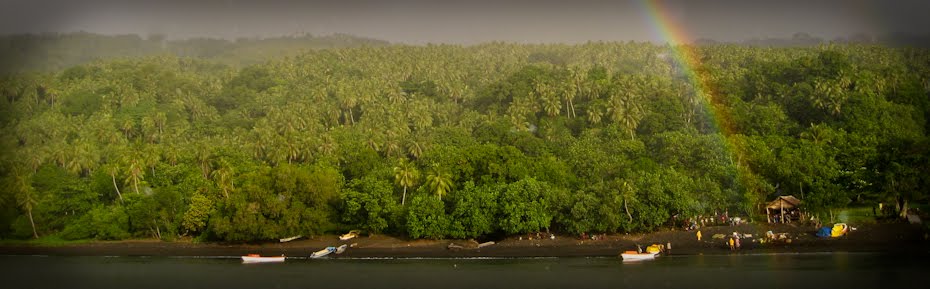
Not having had much chance to talk to our families, or have any quiet time to ourselves, we wandered down to the black-sand beach for some quiet time and the opportunity to make phone calls. Almost to the beach, we noticed children playing with their teacher during a break. They are so curious when we take their pictures to see what we have captured.
Thursday
Today we talked with a variety of people from the village. After having some small conversation with everyone over breakfast, we moved into the bush kitchen and continued our conversations while helping them peel Kumala and Taro. We were soon informed that the leadership had set aside time for us to speak before the council the following afternoon in order to more specifically address the reasons for our visit. What an awesome opportunity. We set aside time to discuss before the meeting how we were going to address them so there would be as little miscommunication as possible. After discussing the details of the presentation amongst ourselves, we returned to visiting with the men in the village.
As we sat chatting, some of the questions we were asked blew me away. They asked about our upcoming presidential election, about the war in Iraq, the monetary crisis, and a few other – more seemingly benign – questions. They had heard of these things over the radio and their knowledge was basic at best, but their interest in these topics surprised me.
The people here tend to be curious about who we are and where we come from and they love pictures. As it turned out, the only picture I had (tucked away in my personal journal) was of a Mule Deer buck I got during one of my last hunting seasons out in Montana, and they loved it. We talked about deer and elk and many of the other animals found in North America. The conversation naturally turned to guns, and bows and arrows. A great afternoon of “storian” increased my Bislama language capabilities immensely. I must admit however, after speaking so much Bislama, my head hurt and I actually felt physically ill – a feeling we all experienced during extended time immersed in Bislama and the local vernaculars.
After lunch, we made our way down to the meeting to formally present our vision for ministry. When we began, there were only a handful of people in the room. At first, it seemed that no one was interested in what we had to say. Within minutes of beginning the meeting, not only had all the leadership and many of the village men packed in for the talk, but many more were gathered around outside, peering into the windows eager to hear.
Houghton, having the best grasp of the trade language thus far, was chosen to give the talk. This presentation was recorded and will be transcribed into Team Minutes for future reference. After the talk, a question and answer period indicated a high level of understanding as to our motives and reasons for being there. After all questions were done, a pastor for the Presbyterian Church in the village offered a prayer. In it, he thanked God for delivering us to them, as we were an answer to their prayers. It is one thing to pray and ask God to prepare people's hearts and minds and to prepare the way for us so that His will would be clearly seen, it is another thing altogether to see it manifest itself right before you and in such a clear and astounding way.
The presentation resulted in the creation of a committee, which is to include leadership from all villages, and churches present on the island within the language group, regardless of denomination. The committee is to prepare for us by finding undisputed land for housing and gardens.
Friday
We had prepared to visit some of the villages further north on the island. These were to include the larger villages of Megham, Olal, Wilit, and the smaller ones in between. We loaded up on a small boat with a few others and began the short boat ride north. We stopped only once to drop off two women at a small beachside village before arriving at our stop in Megham. We helped unload some cargo for one of the men and helped him carry it up a small winding path to his home. He helped us by soliciting for a truck transport that would carry us further north on the small two-track road to the villages we wished to survey.
While we were waiting for the truck to come, we took the opportunity to browse and take mental inventory of the shop that was there in Megham. Very basic items were available for purchase here. We ourselves bought a couple of pens and a package of crackers. It was noteworthy that, here, as in many other places, rice prices were extremely high, and as a result, not much was being stocked. They did inform us however, that we could order whatever we wanted through them and they could have it shipped with their normal store order and we could pick it up there. That is probably very similar to how mail will work in the future as well.
When the truck finally showed up, we agreed with the driver on a price for the day and hopped the tailgate into the back. Riding in the back of a truck on the outer islands can be fun, but also very dangerous. You must keep a vigil watch for low-hanging branches, as they are a very real danger. Whenever you want to stop, for whatever reason, you simply slap the side of the truck loudly and the driver will pull over. We were his only fare for the day so he was more than happy to oblige.
I was impressed simply by the fact that they even had a road. We were informed that they have two trucks that use this road and they are mainly used to haul copra to the beaches for ships such as the MV Brisk to pick up. Having only two trucks on the road has kept it in fairly good condition. A few rough spots required us to put the truck in 4WD, in addition to one part of the road far to the north that had essentially washed out. This washout virtually cut the small, remote village of Wilit off from anything other than foot traffic.
We meandered our way through coconut plantations, along stretches of beach, and small villages dotting the coastline. Under the South Pacific sun, we drove north as far as the well-used Toyota could take us. We then walked the rest of the way to Wilit. A very quiet village of maybe 200 people with only a rudimentary water system (one or two community rain catchments), Wilit is located on a hill with views of the water far below, broken as it is, through the trees. Beyond this destitute settlement, there is one last village further on, accessible only by a small footpath in excessively tough terrain, named Konkon.
Having stopped and spent a small amount of time in the small village of Olal, we found that it has a decidedly catholic flavor with a large cathedral, built overlooking the island of Pentecost some time ago, that looks completely out of place – this having nothing to do with its run-down state of appearance. They currently run a small school that teaches in French, and are petitioning for funds to help maintain the buildings.
We made our way back to Megham where we met with the son of a man who published a hymnal in some of the native dialects. We were hoping to get some information on how he had collected these works and possibly procure any notes he may have had. However, it is unfortunate that his father, the man who wrote the book, had just died only a few weeks prior. We passed his freshly adorned gravesite on our way down to the shore to catch the boat for our return trip to Ranon.
Saturday
(We are going to leave Saturday's adventure for a separate post, coming soon!)
Sunday
God has intended this day for rest, and on this occasion especially – we were in no condition to argue the point. We had exhausted ourselves with trips, survey work, and – not the least of which – language acquisition. It has astounded me the amount of physical fatigue sets in when one simply sits and listens to an unfamiliar language. The time on Ambrym had improved my Bislama immensely to be sure, but listening to Bislama and their native language at times made me feel ill to my stomach because of the intellectual strain.
We attended a village church, the experience only solidifying in our minds their need for teaching and understanding of God's word.
Monday
The time for our departure had arrived. We needed to make our way from the Northern parts of Ambrym to the South where the airstrip is located. We would be flying back to Efate (home). We chartered a boat to take us south along the west coast of Ambrym to Craig Cove in anticipation for our flight out the following morning. Phillip accompanied us on this leg of our journey as well. What a friend. It was pouring down rain as we left Ranon behind us. Great grey clouds threatened to drench us as we made our way down the coast, but to me, the rain was a Godsend. Being wet is an unpleasant fact in the tropics, so if I were to choose, I would choose to be drenched by a rainy, cloud-filled sky, than by sweat under a relentless sun any day.
On our trip down the coast we stopped only twice before our final destination. The first was at a hot spring near where we had all our fun the previous Saturday. The hot spring was just that – HOT! We could barely put our feet into the water without flinching. This hot spring was more than just a hot spring- it was a river. It was a refreshing stop on a cloudy rain-soaked day. The locals will actually use this simmering river to cook bananas and other snacks to go. The second place we stopped was a place called Lake Lonwolwol. This is a freshwater lake that used to be a large village with a hospital. All were lost however in 1913 when the volcano erupted and molten lava changed the landscape and created a large lake where men had once lived.
Shortly after this stop, we arrived in Craig Cove and found lodging at Sam’s Bungalow’s for a mere 1500 vat for the nights rest and food. It is a very nice place with simple amenities. When we arrived, it was just prior to the lunch hour so we dropped our bags in our room, and sat and visited for a bit. We ate lunch and were introduced to the other guests staying there. A couple from Germany had just returned from a trek to the volcano. We were all extremely tired, and a couple of us were not feeling well, so we turned in for the afternoon and slept. I awoke just prior to dinner; in time to experience, what I would later find out was a 5.3 earthquake.
Tuesday
Finally, the day of our departure had dawned. We were excited to get back home to our wives and children. Though we had only been gone a week, time on the islands seems to slow down quite a bit so it seemed much longer. Throwing our packs over our backs and hiking down the road to the terminal was refreshing. We checked our bags, paid our departure tax, and waited for our plane to arrive.
The runway had once been paved, probably in WWII. Now it was little more than a grass airstrip. Hanging around the terminal were people from a nearby village. They weren’t waiting on anything in particular, that just seemed to be the place to hang out. We found out that we were the topic of the latest rumors of goings on for this little island ...and so the 'kava-vine' goes.
- - - - - - - - - - - - - - - - - - - - - - - - - - -
Since returning from this trip, we have been in contact with Phillip. The committee has been set up and is discussing and working towards what it will take for us to establish ministry in North Ambrym, that is if that is the Lord's will. Thank you for praying with us, and please continue to pray. Another survey trip is coming up. The plan from the beginning was to visit several areas of Vanuatu in search for where we would be most effective in the Lord's work, seeking out the place that He has prepared for us to serve. So off on another survey it is. We (the guys) leave tomorrow. So very soon we will have more to share with you. In the mean time, keep checking in. We have a ton more stuff to share with you here on the blog we just want to make sure you are getting a chance to see it all before we add more, we dont want to overload you. Let us know you've been here. We love to hear from you guys!
God bless, and Happy Thanksgiving!
Jim, Tania, Grace, and Josh
> > >


No comments:
Post a Comment